Finding the best dog breeds for seniors isn’t as simple as Googling a list and picking the cutest face. We dug deeper — pulling real opinions from senior communities on Reddit and Quora, getting on the phone with local veterinary professionals, and leaning on the proven wisdom of the most-watched dog trainer in America. Then we put it all through a practical filter: size, temperament, grooming burden, exercise needs, and how well the breed holds up in a Florida-style retirement lifestyle. Two breeds rose to the top. Here’s exactly how we got there.
Table of Contents
What Reddit Seniors Say About the Best Dog Breeds for Seniors
Reddit’s senior and dog-owner communities are surprisingly candid — and the patterns are consistent. Across multiple threads on r/dogs, r/AskDogOwners, and senior-focused forums, a few breeds kept surfacing with passionate personal endorsements.
Greyhound
Retired Greyhounds drew consistent praise for best dog breeds for seniors, with one user putting it simply: “Retired greyhounds are a great bet. Fully adult so a bit more chill, and they tend to be quite lazy chilled dogs anyway. Short, fine coat so minimal grooming required.” That said, users who wanted a smaller footprint pointed to Italian Greyhounds or Whippets, with one noting: “Instead of a full-sized greyhound, I would go with either an Italian greyhound or a whippet. Both are a smaller size that would be easier to carry if needed.”
Cavalier King Charles Spaniel
The Cavalier King Charles Spaniel came up repeatedly in mental health threads. One Reddit user described the profound difference the breed made: “I brought my Cavalier home a year and a half ago and she’s made a profound difference for my mental health.”
Poodle
Poodles got a shout-out for brains and walkability. One commenter summed it up: “Poodles are good to walk. They’re easy and they’re extremely bright and loving. It’s a great dog for elder people.”
On Quora, the conversation around best dog breeds for seniors leaned more practical. Senior users highlighted short-coated breeds as the smarter low-effort pick, noting that “a shorthaired dog would be easier with less upkeep,” and recommending Pugs as a specifically senior-friendly option — “fun and affectionate” with minimal exercise requirements.
The consistent Quora takeaway: breed matters less than maturity and training — “an older dog with a slower disposition, calmer personality traits would be a good idea.”

Best Dog Breeds for Seniors: What a Veterinarian Says
We consulted published guidance from Dr. Jacqueline Brister, DVM, a registered veterinarian and pet expert at Embrace Pet Insurance, who has spoken specifically on this topic.
Dr. Brister’s first directive: “Prospective senior owners should research a breed to ensure maintenance, exercise, and grooming needs match their lifestyle.”
On the practical physics of senior dog ownership, Dr. Julie Hunt, also a veterinarian at Embrace Pet Insurance, was direct about size: “It can be easier to care for a smaller dog than a larger dog. What if the dog gets hurt and needs help getting around? A smaller dog is easier to get in and out of the car to go to the veterinarian or to the groomer, and can fit under an airplane seat, should the senior wish to travel.”
On the Cavalier specifically, Dr. Hunt noted: “The Cavalier was bred as a dog to snuggle with royalty, and it excels at its job. This adorable small breed has a sweet, intelligent personality that will endear itself to any owner.”
Dr. Anita Kinscher-Juran, DVM of VCA Midpark Animal Hospital, brought it home on the health side: “Dogs give seniors a reason to get up and move — and walking a dog keeps them fit.” She also flagged an underrated move for active seniors who don’t want puppy chaos: adopting an older Beagle is “a less physically demanding choice” since younger beagles require more consistent exercise.
One note for Southwest Florida seniors specifically: Flat-faced breeds — Pugs, French Bulldogs, English Bulldogs — can struggle in heat. Veterinary experts caution that “flat-faced breeds can have compromised respiratory systems, which means they may encounter breathing issues in tropical climates.” Keep that in mind before falling for a Frenchie.
What the Dog Whisperer Says the Best Dog Breeds for Seniors Are
Cesar Millan may not have written a senior-specific playbook, but his framework applies directly to this question. His two most quoted principles are the ones that matter most here.
First, on matching energy levels — which is the entire point of this exercise:
“There are four levels of energy, regardless of the breed: low, medium, high, very high. The idea is to get a dog in your same level or lower than you.”
— Cesar Millan
The Dog Whisperer also states, “There is no such thing as a problem breed. However, there is no shortage of problem owners.”
The takeaway for us? The breed narrows the field, but the individual dog’s energy and temperament close the deal. Millan’s framework says to prioritize energy match above aesthetics, size, or popularity — and that’s exactly the lens we used to land on our top two picks for best dog breeds for seniors.
Our Top 2 Best Dog Breeds for Seniors
How We Scored Them
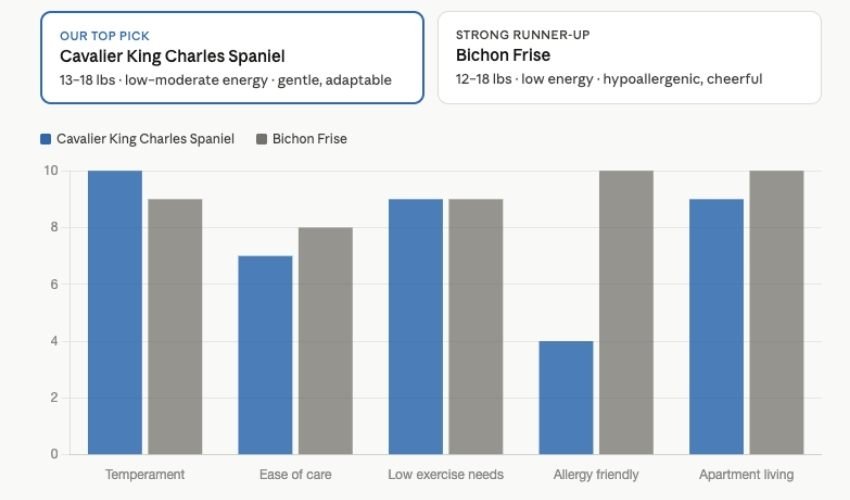
We put every commonly recommended senior dog breed through five practical filters, weighted for real retirement life in Southwest Florida:
- Temperament — gentle, non-reactive, good with grandkids and strangers
- Ease of care — grooming burden, known health issues, vet costs
- Low exercise needs — manageable with a short daily walk
- Allergy friendly — low-shed or hypoallergenic coat
- Apartment / community living — quiet indoors, small enough for 55+ communities
The chart above shows how our top two compare. Here’s the full breakdown.

 #1 - Cavalier King Charles Spaniel
The pick for seniors who want a true companion dog.
Weighing just 13 to 18 pounds, Cavaliers are small enough to curl up in your lap but sturdy enough for a gentle walk around the neighborhood. Their defining trait is an incredibly sweet, gentle disposition — they form deep bonds with their owners and are content whether you are watching television together or strolling through a park.
Pros:
- Adapts completely to your activity level — couch day or walking day, they’re in
- Deeply affectionate without being needy or anxious
- Quiet — rarely a barking problem in community living
- Excellent with grandchildren and other pets
- Laidback, intelligent, and welcoming to people of all ages
Cons:
- Silky coat requires brushing a few times a week to prevent tangles
- Known breed health issue: heart conditions (mitral valve disease) — vet checkups matter
- Brachycephalic build means limited tolerance for excessive exercise or extreme heat — relevant if you’re in SWFL
- Not hypoallergenic
Bottom line: If your primary goal is a dog that genuinely bonds with you and adjusts to your pace of life, the Cavalier wins. The heat caveat is real for Florida seniors — keep them inside during peak afternoon hours.
#2 - Bichon Frise
The pick for seniors who want low-maintenance charm with allergy-friendly credentials.
The Bichon Frise combines a friendly, playful personality with practical benefits for senior owners. These small, fluffy companions typically weigh 12–18 pounds and are known for being one of the most cheerful breeds. Bichon Frises shed minimally, which keeps homes cleaner and reduces allergen concerns.
Pros:
- Hypoallergenic — a genuine differentiator for seniors with allergies
- Adjusts to the energy level of their owner
- Low-shedding coat means less cleanup
- Naturally social — good in senior communities with lots of foot traffic
- Not difficult to potty train, easy for first-time dog owners
- Portable and well within size limits for most 55+ communities
Cons:
- Requires professional grooming every 5–6 weeks — ongoing cost to factor in
- Can develop separation anxiety if left alone for long stretches
- More playful energy than a Cavalier — not a pure lapdog
Bottom line: The Bichon is the smarter practical pick for seniors with allergies, tighter budgets around vet care, or those living in managed communities with strict pet policies. The grooming cost is the real trade-off.
Just for Fun: A Few Bonus Senior Dog Awards
During our research, a few extra “best of” categories kept coming to mind. These are not formal rankings, but they are helpful if you already know what kind of companion would fit your life best.
Best Lap Dog: Cavalier King Charles Spaniel
If your dream dog is happy curled up beside you, the Cavalier is hard to beat. This breed was practically designed for companionship and tends to thrive on closeness, routine, and gentle affection.
Best Travel Companion: Bichon Frise
Small, social, and usually within manageable size limits, the Bichon can be a strong fit for seniors who travel, visit family, or split time between homes. Their cheerful temperament helps, too — though grooming needs still have to be planned for.
Best Sleep Snuggler: Cavalier King Charles Spaniel
Cavaliers are known for wanting to be near their people. For seniors who want a calm, affectionate dog that settles easily into quiet evenings, this breed has the edge.
Most Hypoallergenic: Bichon Frise
No dog is truly allergy-proof, but the Bichon’s low-shedding coat makes it one of the better options for seniors who are sensitive to pet hair or want less cleanup around the home.
Best Small “Protection” Dog: Miniature Schnauzer
A small dog should not be counted on for physical protection, but some breeds are excellent little alert systems. The Miniature Schnauzer is smart, watchful, and more likely to let you know when something unusual is happening — without being too large to manage.
Does Having a Dog as a Companion Improve Your Mental Health?
For many seniors, the right dog offers more than companionship. A steady, affectionate pet can add structure to the day, encourage gentle movement, reduce loneliness, and create a comforting sense of routine. Even small moments — a morning walk, a dog curled beside you, or a happy greeting at the door — can make home feel less quiet.
That does not mean a dog is the right answer for every senior. Pets require money, energy, planning, and backup support. But for the right person, the right dog can become part of a healthier emotional rhythm: something to care for, laugh with, talk to, and look forward to each day.
This is one reason we believe the “best dog breed for seniors” conversation should go beyond size, cuteness and grooming. The real question is whether the dog fits your life in a way that supports your peace, independence, and mental well-being.
Now We Want to Hear From You
We did the research, we ran the numbers, we asked the experts — but the best dog for you is the one that fits your life, not a scoring matrix.
What’s your pick of the litter? Do you have a senior-friendly dog that deserves to be on this list? Have a breed that surprised you — or one that looked great on paper and didn’t deliver? Drop it in the comments. Southwest Florida seniors, we especially want to hear what’s working for you in this heat.
SWFLSenior.com
Practical information for older adults in Southwest Florida — from housing and healthcare to local resources and community connections. Your life. Your choices.